Athletes and coaches
Your effort, as your coach sees it.
Athletes rate how hard they worked and how well they played. Coaches and teammates rate the same two things. The gap between those views, week by week, is where the coaching conversation starts.
For athletes 13 and over. Parents can be invited as reviewers.
How it works here
01
Name the thing to get better at
Composure on the ball. Seeing the game a moment sooner. Organizing the players around you. Sport examples are built in, or write your own in a sentence.
02
Rate after training and matches
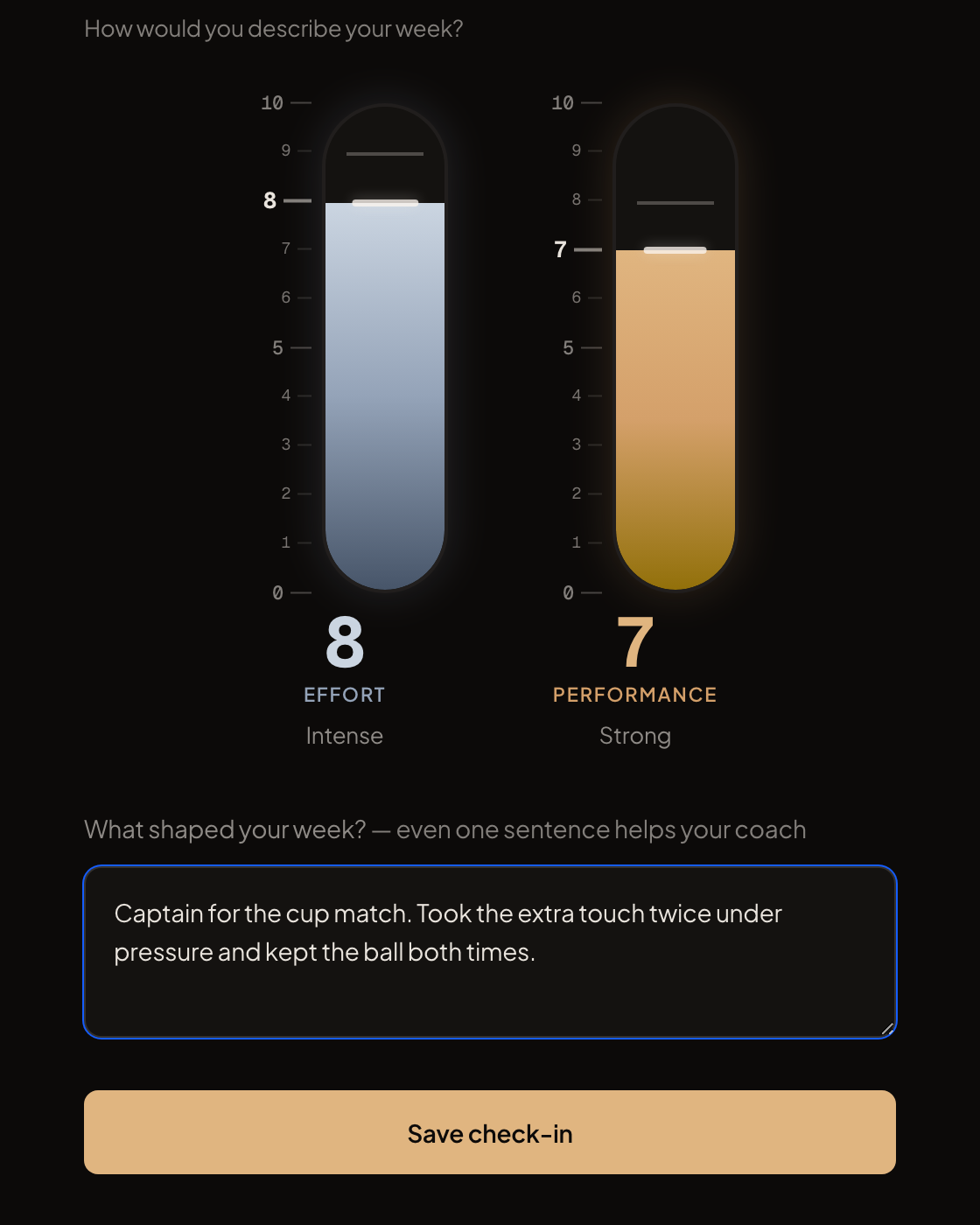
Effort and performance on a 0 to 10 scale, plus a note on what shaped the week. Under a minute, from a phone.
03
Coach, teammate, parent
Whoever sees the player in action rates the same two things. Sixty seconds, no account, from their phone.
04
Talk about the data, not the vibe
Player and coach see the same chart, so the conversation starts from the same place.
Effort is not the same as effect
Athletes often rate their effort higher than their coach does.
That is not laziness and it is not a harsh coach. It is the difference between how hard it feels and how it looks from the touchline. Twelve weeks of both views is how a player learns to make the work show.
Effort, as rated weekly
- You
- Your coach
3to0
Gap between your view and theirs, week 1 to week 12.
For clubs and academies
What it asks of a coaching staff.
- ✓A coach rates each player in about a minute a week, from their phone, between sessions.
- ✓Journeys run twelve weeks, which fits a pre-season, a half, or a block of a season.
- ✓Pricing is per player per journey. Coaches, teammates and parents who review are free.
- ✓Reviewer links are in English today.
Two minutes
Watch how a team uses it.
What the coach gets
A brief before the next session, written from the data.
This one was generated by the product from a demo journey: one check-in, one coach rating, one coach note. It is the conversation a coach would otherwise have to reconstruct from memory.
AI coaching brief: Maya
Generated Monday 07:00, before the session
Headline
Maya is working hard but not seeing it translate. A 3-point effort-to-performance gap suggests the work is not yet aimed at the actual problem: rushing the pass under pressure.
Key data points
- Self-rated effort 7, performance 4. Classic grinding without a clear method.
- Coach sees less effort 6, better performance 5. Maya may be conflating trying hard with effective practice, and is harder on the result than the people watching.
- "Film two matches" is in the notes and has not happened. Intention and execution are diverging.
Conversation starters
- "Walk me through what you actually did this week to work on composure, not what you intended."
- "You gave yourself a 4 and your coach saw a 5. What are you being harder on yourself about?"
- "The filming has not happened yet. What got in the way?"
An experiment to propose
Film ten minutes of one match, the stretch when a rushed pass is most likely. Watch it once without judging. Lower the barrier until the filming actually happens.
One squad. One block of the season.
Bring a goal from your own team to the demo and we will build it on the call.
Individuals can start free today. Coaches and organizations are priced per participant per journey; reviewers are always free.